
Master Distributor

Professional Home Care
Make high-assistance home care easier to deliver.
Carebidet automates in-bed toileting for appropriate bedbound, mobility-challenged and incontinent clients—helping reduce repetitive toileting work while professional caregivers stay focused on the whole person.
Where the workload builds
Toileting care is rarely just one task.
For a high-assistance client, one episode can involve responding, transferring or repositioning, cleaning, changing pads or linens, disposing of supplies and resetting the environment. At night, the same work can interrupt sleep and add strain to already demanding cases.
Caregiver time
Repeated toileting and cleanup can consume meaningful portions of a shift that could otherwise go to supervision, nutrition, mobility, companionship and other care needs.
Handling & repositioning
Traditional bed-based hygiene may require rolling, lifting and repositioning; bathroom toileting can add transfer assistance for clients who can safely transfer.
Nighttime demands
Published home-care research links nocturia and nighttime toileting assistance with caregiver burden. Automation may reduce the hands-on work required for appropriate users.
Hygiene & moisture
Carebidet removes waste through a sealed pathway, washes with water and dries with warm air, supporting a cleaner, drier care process.
Consumables
Wipes, gloves, pads and linens are small costs individually, but repeated use adds up across high-assistance cases.
Caregiver sustainability
Reducing repetitive, intimate and physically demanding tasks may help make complex home-care assignments more manageable. Retention benefit is a reasonable potential—not a proven Carebidet outcome.
Context: home-care toileting studies report physical, emotional and financial burden associated with toileting assistance, including associations with nocturia, nighttime assistance, leakage, odor and disposal costs. Shogenji et al., 2024 → PLOS ONE, 2024 →

What this can look like
More attention to the person. Less time lost to repetitive cleanup.
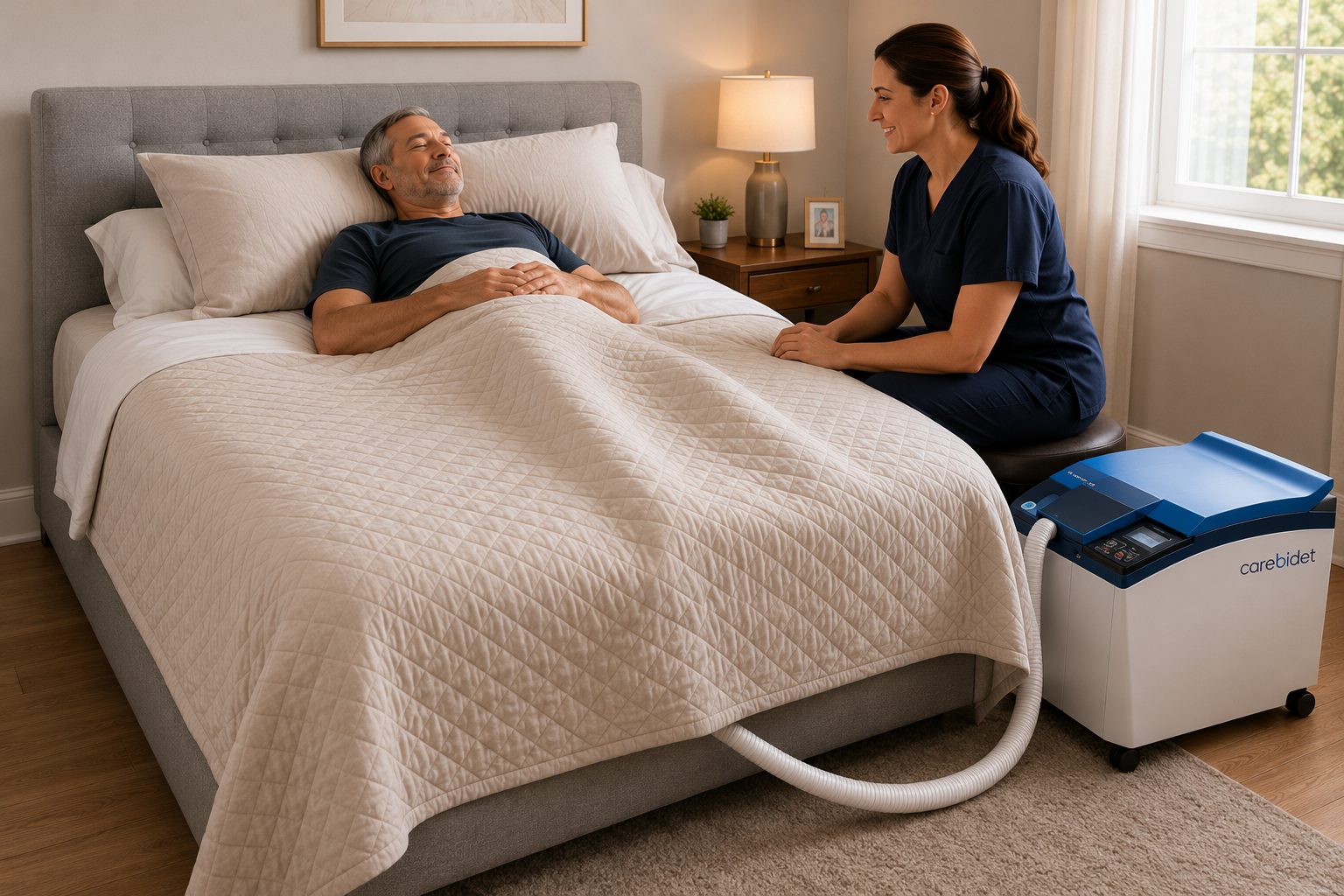
For an appropriate client, Carebidet can support the toileting routine while professional caregivers stay focused on comfort, observation, communication and the rest of the care plan.
Technology supports the routine. Professional caregivers remain focused on the whole person.
What changes in the work?
Move repetitive toileting tasks from manual care to automated support.
More caregiver time is spent on repeated manual toileting tasks.
Key toileting functions are automated while the caregiver stays focused on the whole client.
Carebidet-specific home-care evidence
What one 21-day home-care pilot observed.
In a single-client Australian home-care pilot, Carebidet use was associated with less hands-on toileting time, fewer lifting/log-roll events, and sharply lower use of wipes, gloves, pads and linens.
Single-subject observational pilot; results are setting-specific and should not be treated as guaranteed agency savings.
Professional caregiver evidence
The functions Carebidet automates are the functions caregivers value.
Caregiver satisfaction after one month of use
Thirty caregivers used the Carebidet excretion-care robot for one month. Service-adequacy scores were positive across nearly every measured attribute, with particularly strong results for durability, effectiveness, convenience and safety. Cost was the only attribute with a slightly negative adequacy score.
What professional caregivers preferred
For excretion-care robots, professional caregivers showed significant positive preferences for automatic waste disposal, combined urine/feces detection, and washing/drying. Automatic waste management had the highest relative importance among the excretion-robot attributes tested.
What’s in it for your agency?
Make demanding home-care cases easier to serve.
Carebidet is not about replacing caregivers. It is about making caregiver time more effective. For the right client, automating routine toileting work may help an agency reduce repetitive hands-on tasks, use scheduled care hours more productively and make complex assignments easier to sustain.
Serve more challenging clients
Carebidet may help agencies support bedbound, incontinent, mobility-challenged and high-assistance clients whose toileting needs can make home care especially demanding.
Use caregiver time better
The Australian pilot observed substantially less hands-on toileting time. Time not spent on repetitive cleanup may be redirected to other client needs within the care plan.
Make difficult assignments more sustainable
Reducing repeated cleaning, changing, rolling and toileting assistance may make selected high-assistance cases less physically demanding for professional caregivers. Retention impact remains a potential benefit, not a proven outcome.
Reduce supply-intensive routines
The home-care pilot recorded large reductions in wipes, gloves and disposable pads/linens. Agencies can compare those categories with their own baseline use and costs.
Support care between visits
When correctly fitted and used, Carebidet can manage toileting episodes day or night without requiring a caregiver to perform every cleanup manually.
Differentiate your agency
Offering an intelligent in-bed toileting option can give families, case managers and referral partners another reason to consider your agency for complex home-care needs.
How it may support growth and profitability
Turn one hard care problem into a stronger service model.
Carebidet does not guarantee growth or margin improvement, but it may help agencies make difficult cases easier to staff, easier to explain to referral sources, and more sustainable to deliver.
Take on harder cases
Support clients whose toileting needs might otherwise be difficult to staff or maintain.
Use hours more effectively
Reduce repetitive toileting work so caregiver time can be focused on other care-plan tasks.
Differentiate your offering
Give families and referral partners a more distinctive answer for complex home-care situations.
Create referral momentum
Build credibility around technology-enabled care for high-assistance clients who need more support at home.
Evaluate agency economics
Compare your own time, supply, and staffing baselines to determine whether Carebidet could improve case economics.
One way to put it into practice
Professional care + Carebidet
Carebidet Care shows how professional in-home caregiving can be combined with Carebidet toileting support—keeping human care focused where it matters most while technology supports routine toileting needs between caregiver interventions.
Clear claim language
What Carebidet does, what has been observed, and what remains potential.
Carebidet demonstrably does
- Detects urine and feces
- Removes waste through a sealed system
- Washes and dries the user
- Allows appropriate users to remain in bed for the toileting episode
Published / observed
- Single-subject home pilot: less toileting time, fewer wipes/gloves/pads and fewer lifting/log-roll events
- 30-caregiver field study: most service attributes exceeded minimum acceptable expectations
- 23-caregiver preference study: strong preference for automated waste handling, detection and wash/dry functions
Reasonable potential
- Lower caregiver workload on selected cases
- More sustainable nighttime care
- Better use of caregiver hours
- Potential labor and consumable savings
- Ability to support some higher-acuity clients at home
Carebidet has not been clinically proven to prevent UTIs, pressure injuries or falls. However, completing an appropriate toileting episode in bed eliminates the bathroom transfer—and therefore removes that specific opportunity for a transfer-related fall. Its cleansing and drying functions also support a cleaner, drier care process. These are practical risk-reduction mechanisms, not proven prevention outcomes.
Who may be appropriate
Start with clients whose toileting care is consuming disproportionate time and effort.
Agency evaluation matters
Carebidet should be assessed for individual fit, positioning tolerance, skin condition, care plan, home environment and caregiver capability. The strongest implementation model includes training, clear responsibility for routine checks and cleaning, and measurement of the agency’s own baseline time and consumable use.
Discuss an agency evaluation →